

Get Prepared for Your CSSLP Exam With Actual 349 Questions
Valid CSSLP Test Answers Full-length Practice Certification Exams
Target Audience
The target candidates for the CSSLP certification are the professionals with the expertise in incorporating security practices, including auditing, authentication, and authorization, into different phases of SDLC (Software Development Lifecycle). This certificate covers software design all through to the implementation stage, testing, and deployment.
Secure Software Operations, Deployment & Maintenance (12%):
- Carry out operational risk evaluation, including system integration, safety criticality, deployment environment, and personnel training;
- Incorporate SLO and SLA;
- Ensure a secure installation, including least privilege, bootstrapping, security policy implementation, secure activation, secrets injection, and environment hardening;
- Support the continuity of operations;
- Acquire security approval to function;
- Securely manage and store security data, including secrets, credentials, configurations, and key/certificates;
- Runtime protection.
NEW QUESTION # 170
John works as a professional Ethical Hacker. He has been assigned the project of testing the security of www.we-are-secure.com. In order to do so, he performs the following steps of the pre-attack phase successfully: Information gathering Determination of network range Identification of active systems Location of open ports and applications Now, which of the following tasks should he perform next?
- A. Fingerprint the services running on the we-are-secure network.
- B. Perform OS fingerprinting on the We-are-secure network.
- C. Install a backdoor to log in remotely on the We-are-secure server.
- D. Map the network of We-are-secure Inc.
Answer: B
Explanation:
Explanation/Reference:
Explanation: John will perform OS fingerprinting on the We-are-secure network. Fingerprinting is the easiest way to detect the Operating System (OS) of a remote system. OS detection is important because, after knowing the target system's OS, it becomes easier to hack into the system. The comparison of data packets that are sent by the target system is done by fingerprinting. The analysis of data packets gives the attacker a hint as to which operating system is being used by the remote system. There are two types of fingerprinting techniques as follows: 1.Active fingerprinting 2.Passive fingerprinting In active fingerprinting ICMP messages are sent to the target system and the response message of the target system shows which OS is being used by the remote system. In passive fingerprinting the number of hops reveals the OS of the remote system. Answer: D and B are incorrect. John should perform OS fingerprinting first, after which it will be easy to identify which services are running on the network since there are many services that run only on a specific operating system. After performing OS fingerprinting, John should perform networking mapping. Answer: C is incorrect. This is a pre-attack phase, and only after gathering all relevant knowledge of a network should John install a backdoor.
NEW QUESTION # 171
Which of the following phases of NIST SP 800-37 C&A methodology examines the residual risk for acceptability, and prepares the final security accreditation package?
- A. Security Accreditation
- B. Continuous Monitoring
- C. Initiation
- D. Security Certification
Answer: A
Explanation:
Explanation/Reference:
Explanation: The various phases of NIST SP 800-37 C&A are as follows: Phase 1: Initiation- This phase includes preparation, notification and resource identification. It performs the security plan analysis, update, and acceptance. Phase 2: Security Certification- The Security certification phase evaluates the controls and documentation. Phase 3: Security Accreditation- The security accreditation phase examines the residual risk for acceptability, and prepares the final security accreditation package. Phase 4: Continuous Monitoring-This phase monitors the configuration management and control, ongoing security control verification, and status reporting and documentation.
NEW QUESTION # 172
Which of the following DoD policies establishes policies and assigns responsibilities to achieve DoD IA through a defense-in-depth approach that integrates the capabilities of personnel, operations, and technology, and supports the evolution to network-centric warfare?
- A. DoD 8500.1 Information Assurance (IA)
- B. DoD 8500.2 Information Assurance Implementation
- C. DoDI 5200.40
- D. DoD 8510.1-M DITSCAP
Answer: A
Explanation:
DoD 8500.1 Information Assurance (IA) sets up policies and allots responsibilities to achieve DoD IA through a defense-in-depth approach that integrates the capabilities of personnel, operations, and technology, and supports the evolution to network-centric warfare. DoD 8500.1 also summarizes the roles and responsibilities for the persons responsible for carrying out the IA policies. Answer D is incorrect. The DoD 8500.2 Information Assurance Implementation pursues 8500.1. It provides assistance on how to implement policy, assigns responsibilities, and prescribes procedures for applying integrated, layered protection of the DoD information systems and networks. DoD Instruction 8500.2 allots tasks and sets procedures for applying integrated layered protection of the DOD information systems and networks in accordance with the DoD 8500.1 policy. It also provides some important guidelines on how to implement an IA program. Answer A is incorrect. DoDI 5200.40 executes the policy, assigns responsibilities, and recommends procedures under reference for Certification and Accreditation(C&A) of information technology (IT). Answer C is incorrect. DoD 8510.1-M DITSCAP provides standardized activities leading to accreditation, and establishes a process and management baseline.
NEW QUESTION # 173
Which of the following are the phases of the Certification and Accreditation (C&A) process? Each correct answer represents a complete solution. Choose two.
- A. Detection
- B. Auditing
- C. Continuous Monitoring
- D. Initiation
Answer: C,D
Explanation:
The Certification and Accreditation (C&A) process consists of four distinct phases: 1.Initiation 2.Security Certification 3.Security Accreditation 4.Continuous Monitoring The C&A activities can be applied to an information system at appropriate phases in the system development life cycle by selectively tailoring the various tasks and subtasks. Answer B and C are incorrect. Auditing and detection are not phases of the Certification and Accreditation process.
NEW QUESTION # 174
Mark works as a Network Administrator for NetTech Inc. The company has a Windows 2000 domain- based network. Users report that they are unable to log on to the network. Mark finds that accounts are locked out due to multiple incorrect log on attempts. What is the most likely cause of the account lockouts?
- A. Spoofing
- B. SYN attack
- C. PING attack
- D. Brute force attack
Answer: D
Explanation:
Explanation/Reference:
Explanation: Brute force attack is the most likely cause of the account lockouts. In a brute force attack, unauthorized users attempt to log on to a network or a computer by using multiple possible user names and passwords. Windows 2000 and other network operating systems have a security feature that locks a user account if the number of failed logon attempts occur within a specified period of time, based on the security policy lockout settings. AnswerA is incorrect. Spoofing is a technique that makes a transmission appear to have come from an authentic source by forging the IP address, email address, caller ID, etc. In IP spoofing, a hacker modifies packet headers by using someone else's IP address to hide his identity.
However, spoofing cannot be used while surfing the Internet, chatting on-line, etc. because forging the source IP address causes the responses to be misdirected. AnswerC is incorrect. A SYN attack affects computers running on the TCP/IP protocol. It is a protocol-level attack that can render a computer's network services unavailable. A SYN attack is also known as SYN flooding. Answer: D is incorrect. When a computer repeatedly sends ICMP echo requests to another computer, it is known as a PING attack.
NEW QUESTION # 175
You work as a Security Manager for Tech Perfect Inc. You have set up a SIEM server for the following purposes: Analyze the data from different log sources Correlate the events among the log entries Identify and prioritize significant events Initiate responses to events if required One of your log monitoring staff wants to know the features of SIEM product that will help them in these purposes. What features will you recommend? Each correct answer represents a complete solution. Choose all that apply.
- A. Graphical user interface
- B. Asset information storage and correlation
- C. Transmission confidentiality protection
- D. Security knowledge base
- E. Incident tracking and reporting
Answer: A,B,D,E
Explanation:
Explanation/Reference:
Explanation: The features of SIEM products are as follows: Graphical user interface (GUI): It is used in analysis for identifying potential problems and reviewing all available data that are associated with the problems. Security knowledge base: It includes information on known vulnerabilities, log messages, and other technical data. Incident tracking and hacking: It has robust workflow features to track and report incidents. Asset information storage and correlation: It gives higher priority to an attack that affects a vulnerable OS or a main host. Answer: B is incorrect. SIEM product does not have this feature.
NEW QUESTION # 176
Which of the following plans is documented and organized for emergency response, backup operations, and recovery maintained by an activity as part of its security program that will ensure the availability of critical resources and facilitates the continuity of operations in an emergency situation?
- A. Contingency Plan
- B. Continuity Of Operations Plan
- C. Disaster Recovery Plan
- D. Business Continuity Plan
Answer: A
Explanation:
Explanation/Reference:
Explanation: Contingency plan is prepared and documented for emergency response, backup operations, and recovery maintained by an activity as the element of its security program that will ensure the availability of critical resources and facilitates the continuity of operations in an emergency situation. A contingency plan is a plan devised for a specific situation when things could go wrong. Contingency plans are often devised by governments or businesses who want to be prepared for anything that could happen.
Contingency plans include specific strategies and actions to deal with specific variances to assumptions resulting in a particular problem, emergency, or state of affairs. They also include a monitoring process and
"triggers" for initiating planned actions. They are required to help governments, businesses, or individuals to recover from serious incidents in the minimum time with minimum cost and disruption.
AnswerD is incorrect. A disaster recovery plan should contain data, hardware, and software that can be
critical for a business. It should also include the plan for sudden loss such as hard disc crash. The business should use backup and data recovery utilities to limit the loss of data. AnswerA is incorrect. The Continuity Of Operation Plan (COOP) refers to the preparations and institutions maintained by the United States government, providing survival of federal government operations in the case of catastrophic events.
It provides procedures and capabilities to sustain an organization's essential. COOP is the procedure documented to ensure persistent critical operations throughout any period where normal operations are unattainable. AnswerB is incorrect. Business Continuity Planning (BCP) is the creation and validation of a practiced logistical plan for how an organization will recover and restore partially or completely interrupted critical (urgent) functions within a predetermined time after a disaster or extended disruption. The logistical plan is called a business continuity plan.
NEW QUESTION # 177
Which of the following NIST Special Publication documents provides a guideline on questionnaires and checklists through which systems can be evaluated for compliance against specific control objectives?
- A. NIST SP 800-59
- B. NIST SP 800-53A
- C. NIST SP 800-60
- D. Explanation:
NIST SP 800-26 (Security Self-Assessment Guide for Information Technology Systems) provides a guideline on questionnaires and checklists through which systems can be evaluated for compliance against specific control objectives. - E. NIST SP 800-37
- F. NIST SP 800-53
- G. NIST SP 800-26
Answer: G
Explanation:
E, C, D, and F are incorrect. NIST has developed a suite of documents for conducting Certification & Accreditation (C&A). These documents are as follows: NIST Special Publication 800-37: This document is a guide for the security certification and accreditation of Federal Information Systems. NIST Special Publication 800-53: This document provides a guideline for security controls for Federal Information Systems. NIST Special Publication 800-53A. This document consists of techniques and procedures for verifying the effectiveness of security controls in Federal Information System. NIST Special Publication 800-59: This document is a guideline for identifying an information system as a National Security System. NIST Special Publication 800-60: This document is a guide for mapping types of information and information systems to security objectives and risk levels.
NEW QUESTION # 178
Which of the following persons in an organization is responsible for rejecting or accepting the residual risk for a system?
- A. Information Systems Security Officer (ISSO)
- B. System Owner
- C. Designated Approving Authority (DAA)
- D. Chief Information Security Officer (CISO)
Answer: C
Explanation:
Explanation/Reference:
Explanation: The authorizing official is the senior manager responsible for approving the working of the information system. He is responsible for the risks of operating the information system within a known environment through the security accreditation phase. In many organizations, the authorizing official is also referred as approving/accrediting authority (DAA) or the Principal Approving Authority (PAA). AnswerC is incorrect. The system owner has the responsibility of informing the key officials within the organization of the requirements for a security C&A of the information system. He makes the resources available, and provides the relevant documents to support the process. Answer: A is incorrect. An Information System Security Officer (ISSO) plays the role of a supporter. The responsibilities of an Information System Security Officer (ISSO) are as follows: Manages the security of the information system that is slated for Certification
& Accreditation (C&A). Insures the information systems configuration with the agency's information security policy. Supports the information system owner/information owner for the completion of security-related responsibilities. Takes part in the formal configuration management process. Prepares Certification & Accreditation (C&A) packages. AnswerD is incorrect. The CISO has the responsibility of carrying out the CIO's FISMA responsibilities. He manages the information security program functions.
NEW QUESTION # 179
Which of the following are Service Level Agreement (SLA) structures as defined by ITIL? Each correct answer represents a complete solution. Choose all that apply.
- A. Component Based
- B. Segment Based
- C. Multi-Level
- D. Customer Based
- E. Service Based
Answer: C,D,E
Explanation:
Explanation/Reference:
Explanation: ITIL defines 3 types of Service Level Agreement (SLA) structures, which are as follows:
1.Customer Based: It covers all services used by an individual customer group. 2.Service Based: It is one service for all customers. 3.Multi-Level: Some examples of Multi-Level SLA are 3 Tier SLA encompassing Corporate and Customer & Service Layers. AnswerC and A are incorrect. There are no such SLA structures as Segment Based and Component Based.
NEW QUESTION # 180
Which of the following scanning techniques helps to ensure that the standard software configuration is currently with the latest security patches and software, and helps to locate uncontrolled or unauthorized software?
- A. Port Scanning
- B. Workstation Scanning
- C. Discovery Scanning
- D. Server Scanning
Answer: B
Explanation:
Workstation scanning provides help to ensure that the standard software configuration exists with the most recent security patches and software. It helps to locate uncontrolled or unauthorized software. A full workstation vulnerability scan of the standard corporate desktop configuration must be implemented on a regularly basis. Answer B is incorrect. The discovery scanning technique is used to gather adequate information regarding each network device to identify what type of device it is, its operating system, and if it is running any externally vulnerable services, like Web services, FTP, or email. Answer C is incorrect. A full server vulnerability scan helps to determine if the server OS has been configured to the corporate standards and identify if applications have been updated with the latest security patches and software versions. Answer A is incorrect. Port scanning technique describes the process of sending a data packet to a port to gather information about the state of the port.
NEW QUESTION # 181
FITSAF stands for Federal Information Technology Security Assessment Framework. It is a methodology for assessing the security of information systems. Which of the following FITSAF levels shows that the procedures and controls are tested and reviewed?
- A. Level 4
- B. Level 5
- C. Level 2
- D. Level 3
- E. Level 1
Answer: A
Explanation:
The following are the five levels of FITSAF based on SEI's Capability Maturity Model (CMM): Level 1: The first level reflects that an asset has documented a security policy. Level 2: The second level shows that the asset has documented procedures and controls to implement the policy. Level 3: The third level indicates that these procedures and controls have been implemented. Level 4: The fourth level shows that the procedures and controls are tested and reviewed. Level 5: The fifth level is the final level and shows that the asset has procedures and controls fully integrated into a comprehensive program.
NEW QUESTION # 182
Which of the following are the benefits of information classification for an organization? Each correct answer represents a complete solution. Choose two.
- A. It helps reduce the Total Cost of Ownership (TCO).
- B. It helps identify which information is the most sensitive or vital to an organization.
- C. It helps identify which protections apply to which information.
- D. It ensures that modifications are not made to data by unauthorized personnel or processes.
Answer: B,C
Explanation:
Following are the benefits of information classification for an organization: It helps identify which protections apply to which information. It helps identify which information is the most sensitive or vital to an organization. It supports the tenets of confidentiality, integrity, and availability as it pertains to data. Answer D is incorrect. The concept of integrity ensures that modifications are not made to data by unauthorized personnel or processes. It also ensures that unauthorized modifications are not made to data by authorized personnel or processes. Answer A is incorrect. Information classification cannot reduce the Total Cost of Ownership (TCO).
NEW QUESTION # 183
Rob is the project manager of the IDLK Project for his company. This project has a budget of $5,600,000 and is expected to last 18 months. Rob has learned that a new law may affect how the project is allowed to proceed - even though the organization has already invested over $750,000 in the project. What risk response is the most appropriate for this instance?
- A. Explanation:
At this point all that Rob can likely do is accepting the risk event. Because this is an external risk, there is little that Rob can do other than document the risk and share the new with management and the project stakeholders. If the law is passed then Rob can choose the most appropriate way for the project to continue. Acceptance response is a part of Risk Response planning process. Acceptance response delineates that the project plan will not be changed to deal with the risk. Management may develop a contingency plan if the risk does occur. Acceptance response to a risk event is a strategy that can be used for risks that pose either threats or opportunities. Acceptance response can be of two types: Passive acceptance: It is a strategy in which no plans are made to try or avoid or mitigate the risk. Active acceptance: Such responses include developing contingency reserves to deal with risks, in case they occur. Acceptance is the only response for both threats and opportunities. Answer B is incorrect. Mitigation aims to lower the probability and/or impact of the risk event. Answer C is incorrect. Transference transfers the ownership of the risk event to a third party, usually through a contractual agreement. - B. Mitigation
- C. Acceptance
- D. Enhance
- E. Transference
Answer: A,C
Explanation:
is incorrect. Enhance is a risk response that tries to increase the probability and/or impact of the positive risk event.
NEW QUESTION # 184
Which of the following describes a residual risk as the risk remaining after a risk mitigation has occurred?
- A. SSAA
- B. DIACAP
- C. DAA
- D. ISSO
Answer: B
Explanation:
Explanation/Reference:
Explanation: DIACAP describes a residual risk as the risk remaining after a risk mitigation has occurred.
The Department of Defense Information Assurance Certification and Accreditation Process (DIACAP) is a process defined by the United States Department of Defense (DoD) for managing risk. DIACAP replaced the former process, known as DITSCAP (Department of Defense Information Technology Security Certification and Accreditation Process), in 2006. DoD Instruction (DoDI) 8510.01 establishes a standard DoD-wide process with a set of activities, general tasks, and a management structure to certify and accredit an Automated Information System (AIS) that will maintain the Information Assurance (IA) posture of the Defense Information Infrastructure (DII) throughout the system's life cycle.DIACAP applies to the acquisition, operation, and sustainment of any DoD system that collects, stores, transmits, or processes unclassified or classified information since December 1997. It identifies four phases: 1.System Definition
2.Verification 3.Validation 4.Re-Accreditation AnswerD is incorrect. An Information System Security Officer (ISSO) plays the role of a supporter. The responsibilities of an Information System Security Officer (ISSO) are as follows: Manages the security of the information system that is slated for Certification & Accreditation (C&A). Insures the information systems configuration with the agency's information security policy. Supports the information system owner/information owner for the completion of security-related responsibilities. Takes part in the formal configuration management process. Prepares Certification & Accreditation (C&A) packages. AnswerC is incorrect. The Designated Approving Authority (DAA), in the United States Department of Defense, is the official with the authority to formally assume responsibility for operating a system at an acceptable level of risk. The DAA is responsible for implementing system security. The DAA can grant the accreditation and can determine that the system's risks are not at an acceptable level and the system is not ready to be operational. AnswerB is incorrect. System Security Authorization Agreement (SSAA) is an information security document used in the United States Department of Defense (DoD) to describe and accredit networks and systems. The SSAA is part of the Department of Defense Information Technology Security Certification and Accreditation Process, or DITSCAP (superseded by DIACAP). The DoD instruction (issues in December 1997, that describes DITSCAP and provides an outline for the SSAA document is DODI 5200.40. The DITSCAP application manual (DoD 8510.1-M), published in July 2000, provides additional details.
NEW QUESTION # 185
A number of security patterns for Web applications under the DARPA contract have been developed by Kienzle, Elder, Tyree, and Edwards-Hewitt. Which of the following patterns are applicable to aspects of authentication in Web applications?b Each correct answer represents a complete solution. Choose all that apply.
- A. Account lockout
- B. Secure assertion
- C. Partitioned application
- D. Password authentication
- E. Authenticated session
- F. Password propagation
Answer: A,D,E,F
Explanation:
Explanation/Reference:
Explanation: The various patterns applicable to aspects of authentication in the Web applications are as follows: Account lockout: It implements a limit on the incorrect password attempts to protect an account from automated password-guessing attacks. Authenticated session: It allows a user to access more than one access-restricted Web page without re-authenticating every page. It also integrates user authentication into the basic session model. Password authentication: It provides protection against weak passwords, automated password-guessing attacks, and mishandling of passwords. Password propagation:
It offers a choice by requiring that a user's authentication credentials be verified by the database before providing access to that user's data. AnswerB and C are incorrect. Secure assertion and partitioned application patterns are applicable to software assurance in general.
NEW QUESTION # 186
Fill in the blank with an appropriate phrase. A is defined as any activity that has an effect on defining, designing, building, or executing a task, requirement, or procedure.
- A. technical effort
Answer: A
Explanation:
A technical effort is described as any activity, which has an effect on defining, designing, building, or implementing a task, requirement, or procedure. The technical effort is an element of technical management that is required to progress efficiently and effectively from a business need to the deployment and operation of the system.
NEW QUESTION # 187
Which of the following are the benefits of information classification for an organization? Each correct answer represents a complete solution. Choose two.
- A. It helps reduce the Total Cost of Ownership (TCO).
- B. It helps identify which information is the most sensitive or vital to an organization.
- C. It helps identify which protections apply to which information.
- D. It ensures that modifications are not made to data by unauthorized personnel or processes.
Answer: B,C
Explanation:
Explanation/Reference:
Explanation: Following are the benefits of information classification for an organization: It helps identify which protections apply to which information. It helps identify which information is the most sensitive or vital to an organization. It supports the tenets of confidentiality, integrity, and availability as it pertains to data.
AnswerD is incorrect. The concept of integrity ensures that modifications are not made to data by
unauthorized personnel or processes. It also ensures that unauthorized modifications are not made to data by authorized personnel or processes. AnswerA is incorrect. Information classification cannot reduce the Total Cost of Ownership (TCO).
NEW QUESTION # 188
ISO 27003 is an information security standard published by the International Organization for Standardization (ISO) and the International Electrotechnical Commission (IEC). Which of the following elements does this standard contain? Each correct answer represents a complete solution. Choose all that apply.
- A. CSFs (Critical success factors)
- B. Inter-Organization Co-operation
- C. Guidance on process approach
- D. Terms and Definitions
- E. Information Security Risk Treatment
- F. ystem requirements for certification bodies Managements
Answer: A,B,C,D
Explanation:
Explanation/Reference:
Explanation: ISO 27003 is an information security standard published by the International Organization for Standardization (ISO) and the International Electrotechnical Commission (IEC). It is entitled as "Information Technology - Security techniques - Information security management system implementation guidance".
The ISO 27003 standard provides guidelines for implementing an ISMS (Information Security Management System). It mainly focuses upon the PDCA method along with establishing, implementing, reviewing, and improving the ISMS itself. The ISO 27003 standard contains the following elements: Introduction Scope Terms and Definitions CSFs (Critical success factors) Guidance on process approach Guidance on using PDCA Guidance on Plan Processes Guidance on Do Processes Guidance on Check Processes Guidance on Act Processes Inter-Organization Co-operation AnswerB is incorrect. This element is included in the ISO 27005 standard. AnswerD is incorrect. This element is included in the ISO 27006 standard.
NEW QUESTION # 189
John works as a professional Ethical Hacker. He has been assigned the project of testing the security of www.we-are-secure.com. He has successfully performed the following steps of the pre-attack phase to check the security of the We-are-secure network: Gathering information Determining the network range Identifying active systems Now, he wants to find the open ports and applications running on the network.
Which of the following tools will he use to accomplish his task?
- A. RIPE
- B. ARIN
- C. APNIC
- D. SuperScan
Answer: D
Explanation:
Explanation/Reference:
Explanation: In such a situation, John will use the SuperScan tool to find the open ports and applications on the We-are-secure network. SuperScan is a TCP/UDP port scanner. It also works as a ping sweeper and hostname resolver. It can ping a given range of IP addresses and resolve the host name of the remote system. The features of SuperScan are as follows: It scans any port range from a built-in list or any given range. It performs ping scans and port scans using any IP range. It modifies the port list and port descriptions using the built in editor. It connects to any discovered open port using user-specified "helper" applications. It has the transmission speed control utility. AnswerC, A, and B are incorrect. RIPE, ARIN, and APNIC are the Regional Internet Registries (RIR) that manage, distribute, and register public IP addresses within their respective regions. These can be used as passive tools by an attacker to determine the network range.
NEW QUESTION # 190
Which of the following features of SIEM products is used in analysis for identifying potential problems and reviewing all available data that are associated with the problems?
- A. Graphical user interface
- B. Security knowledge base
- C. Incident tracking and reporting
- D. Asset information storage and correlation
Answer: A
Explanation:
Explanation/Reference:
Explanation: SIEM product has a graphical user interface (GUI) which is used in analysis for identifying potential problems and reviewing all available data that are associated with the problems. A graphical user interface (GUI) is a type of user interface that allows people to interact with programs in more ways than typing commands on computers. The term came into existence because the first interactive user interfaces to computers were not graphical; they were text- and-keyboard oriented and usually consisted of commands a user had to remember and computer responses that were infamously brief. A GUI offers graphical icons, and visual indicators, as opposed to text-based interfaces, typed command labels or text navigation to fully represent the information and actions available to a user. The actions are usually performed through direct manipulation of the graphical elements.
NEW QUESTION # 191
DRAG DROP
RCA (root cause analysis) is an iterative and reactive method that identifies the root cause of various incidents, and the actions required to prevent these incidents from reoccurring. RCA is classified in various categories. Choose appropriate categories and drop them in front of their respective functions.
Answer:
Explanation:
Explanation: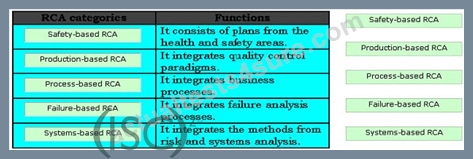
The various categories of root cause analysis (RCA) are as follows: Safety-based RC A.
It consists of plans from the health and safety areas. Production-based RCA. It integrates quality control paradigms. Process-based RCA. It integrates business processes. Failure-based RCA. It integrates failure analysis processes as employed in engineering and maintenance. Systems-based RCA. It integrates the methods from risk and systems analysis.
NEW QUESTION # 192
In which of the following phases of the SDLC does the software and other components of the system faithfully incorporate the design specifications and provide proper documentation and training?
- A. Programming and training
- B. Initiation
- C. Design
- D. Evaluation and acceptance
Answer: A
Explanation:
In the programming and training phase of the SDLC, the software and other components of the system faithfully incorporate the design specifications, and proper documentation and training are provided. Answer D is incorrect. During the initiation phase, the need for a system is expressed and the purpose of the system is documented. Answer A is incorrect. During the design phase, systems requirements are incorporated into design. This phase specifies to include controls that support the auditing of the system. Answer B is incorrect. During the evaluation and acceptance phase, the system and data are validated, all the control requirements and the user requirements are met by the system.
NEW QUESTION # 193
Which of the following documents were developed by NIST for conducting Certification & Accreditation (C&A)? Each correct answer represents a complete solution. Choose all that apply.
- A. NIST Special Publication 800-37
- B. NIST Special Publication 800-53
- C. NIST Special Publication 800-59
- D. NIST Special Publication 800-60
- E. NIST Special Publication 800-37A
- F. NIST Special Publication 800-53A
Answer: A,B,C,D,F
Explanation:
NIST has developed a suite of documents for conducting Certification & Accreditation (C&A). These documents are as follows: NIST Special Publication 800-37: This document is a guide for the security certification and accreditation of Federal Information Systems. NIST Special Publication 800-53: This document provides a guideline for security controls for Federal Information Systems. NIST Special Publication 800-53A. This document consists of techniques and procedures for verifying the effectiveness of security controls in Federal Information System. NIST Special Publication 800-59: This document is a guideline for identifying an information system as a National Security System. NIST Special Publication 800-60: This document is a guide for mapping types of information and information systems to security objectives and risk levels. Answer C is incorrect. There is no such type of NIST document.
NEW QUESTION # 194
......
Accurate & Verified 2024 New CSSLP Answers As Experienced in the Actual Test!: https://surepass.actualtests4sure.com/CSSLP-practice-quiz.html
